Sunday, August 4, 2024

Australian Housing Affordability Crisis

There should be a sense of urgency in addressing the current "Housing Crisis":
We're adding almost another Sydney or Melbourne over the next decade, 3.7 million people.

For the 160,000 new houses per year, we'll need 400 square-km each year, or 4,000 sq-km over the decade. At least one third the total size of Greater Sydney.

How do we even fit that in? 

Australia has been settled mostly on the coast, a thin band at most 50km wide, between the sea and mountains. Where all the good water and best agricultural land once was.
We might have 7+ million km2 of total land, but only a fraction is arable and we need to carefully preserve and curate our best land.

The Greens new Housing Policy is "Business as Usual", but with a stated goal of "stopping" price growth.

There's a fundamental misunderstanding by the Greens:
the System is working Perfectly, as it was Designed to. [ see Berwick's Central Law ]

There's very good reason that Real Estate Agents have wall posters proclaiming:
Real Estate, The Source of All Wealth.

They've never seen the market collapse, despite millions of home owners being highly leveraged, making a huge, life-defining bet on a single asset in a single asset class. This is insanely risky.

Steadily increasing house prices is a design feature of our Residential Property Market, it can't be "fixed", unless the System itself is changed.

We've got three related and simultaneous problems:
  • creating mass affordable housing, ensuring anyone on the average adult wage can afford a mortgage, back to 1950's and 70's affordability with a 2x - 3x ratio of median price to avg wages.
    We've got to service the backlog of unsatisfied demand plus all new arrivals.

  • Create this new "city", larger than any but Sydney & Melbourne, of housing somewhere people will want to live and stay, while being able to access work in major cities easily and affordably.

  • We can't wreck the existing housing market, valued at over $10 Trillion-with-a-T, around 5 times our GDP or Stock Market or three times our total Superannuation savings.
Whitlam in the early 1970's understood the problem of the housing market and attempted to create a regional development pipeline, starting with Albury-Wodonga. The attempt stalled.

It doesn't take 3-6 months to build a house.
The record at Levittown was 18 houses completed in 4 hrs.
The Empire State building, over 100 floors, went up in 410 days. They installed a railway on each floor and had on-site production lines.

With today's new tools, machines, methods and machinery, it should be possible to dramatically lower build times and costs.

One critical factor is 'lowering expectations', or demands, of new home buyers.

It's a housing ladder, it's many steps to your "dream home" & lifestyle, but the most important is starting, getting onto the ladder with an entry level property you can pay off quickly and consider what next.

Residential Properties are assets, they have to also be treated as financial investments.
It makes no sense to put a $1M house on a $50k block of land, or a caravan on a $1M block.
Neither will ever sell for close to costs.

Properties can't be over- or under-capitalised, the value of the building has to be proportionate to the cost of the block it sits upon.

Which creates demand for large, expensive "Dream Homes" with all the inclusions, with developers pricing blocks accordingly, via what they pay for the original land, then the high cost will bleed first owners dry over time. They're not buying for their needs, but hopes & desires.

Until and unless there's total land + house packages, in attractive communities, available for $300k (3x avg earnings), there's no solution to the system that's designed to constantly push house prices skywards.

$150k doesn't buy much if built by others, but with factory assembled parts and modest DIY skills, a liveable, comfortable, efficient and individualised small house for singles and couples is entirely possible.

We just have to want to do it.
02 Aug 2024
... we know Australia will grow by around 3.7 million people in the coming decade,
[ 365,000 / yr = 1,000/day ]
400 sq-km for 160,000 houses / year
= 400k ppl @ 2.5pp/house
= 1k ppl/sq-km

[ At same density as Eastern Suburbs of Sydney ]
2.7pp / household = 365k / 2.7 = 100k houses / year
1,000 pp/sq-km = 365k/1k = 365 sq-km / year

= 4,000 sq-km in a decade 


https://soe.dcceew.gov.au/coasts/pressures/population

Australia is an urban coastal nation.

In 2001, 85% of Australia’s population lived within 50 kilometres (km) of the coast, but by 2019, that proportion had risen to 87%.

This equates to over 22 million Australians now calling the coast home.


https://www.ga.gov.au/scientific-topics/national-location-information/dimensions/australias-size-compared

Australia covers 7 688 287km2


Greens 2023 Housing Policy
https://www.thenewdaily.com.au/finance/finance-news/2024/07/23/housing-negative-gearing-cgt
A long-held truism across the federal Parliament is that Australian voters like rising property prices so much that any-self interested politician would be silly to propose plans to curb it.

But as average income earners in Sydney, Melbourne and Brisbane are increasingly priced out of the suburbs they grew up in, there's a growing push to shift the debate towards affordability.

Greens housing spokesperson Max Chandler-Mather echoed the plight of first-home buyers in The Australian on Tuesday, calling for house price growth to be brought back in line with income.

"Our goal, our stated goal, is to stop house price growth," he said.

"So zero per cent growth to give wages a chance to catch up.

"The net effect would be a stabilisation of house prices."


Berwick, in 1996, defined the "Central Law of Improvement":

Systems deliver exactly what they're designed to deliver


Berwick, BMJ 1996
A primer on leading the improvement of systems
http://app.ihi.org/Events/Attachments/Event-2680/Document-4562/Berwick_1996_A_primer_on_leading_the_improvement.pdf

Central Law of Improvement:
Not all Change is Improvement, All Improvement is Change.

Systems deliver exactly what they're designed to deliver.

Therefore, Change The system, not actors & rules.


https://www.amazon.com/You-Want-into-Real-Estate/dp/B002KZQEU8
So, You Want to Go into Real Estate?:
The Source of All Wealth


Quarterly Essary: QE92 - November 2023
Alan Kohler
The Great Divide: Australia's Housing Mess and How to Fix It
https://www.quarterlyessay.com.au/essay/2023/11/the-great-divide

Kohler's graphs provide definitive evidence the long-term ratio of Median House price and Average Earnings broke out in 2000.
Fuelled by Howard's changes to Capital Gains Tax, Negative Gearing and low interest rates.
A deliberate strategy of John Howard, alongside the windfall $180+B tax from the Mining building boom,
tax cuts creating a structural deficit.

He notes that unwinding the situtation back to the previous long-term ratio of 3.5 is difficult.
The closest he comes to a solution is (someone) holding house prices steady
and, assuming wage growth of 4%/year, then waiting for 20 years.

Only that's not supported by the recent decade-long stagnation of wages & ignores external shocks,
to which Australia is extremely vulnerable as a commodities exporter:
  • collapse in demand for our commodities
  • supply chain issues
  • sudden & prolonged shift in foreign exchange rates


After the party: how Australia spent its mining boom windfall
28 MAY 2012
https://apo.org.au/node/29573
The result was a windfall to our public coffers of at least $180 billion over the six years from 2002 to 2008.


"Temporary Boom, Permanent Tax cuts/Promises", Chris Richardson, 2014


19/09/2003, John Howard, on constantly increasing house prices.
https://pmtranscripts.pmc.gov.au/release/transcript-20920

Q: I wonder if I could ask you to respond to how you see the over heated housing market in Australia?

A: Anybody who owns a house is very happy that the value of that house has gone up, let's be quite straight about that.
I haven't found anybody in seven and a half years shake their fist at me and say
Howard I'm angry with you for letting the value of my house increase."

Q: I think house prices have doubled nationally since 1996, haven't they?
A: My point is that we have, in a sense, become the victims of our own prosperity and success.


Notes on Housing.

1. The current housing model of Everyone in One Big City is broken, the system is a major part of the problem.

2. Australia has lots of suitable land to build housing on, just very little inside existing Capitals.
We know Whitlam understood this, but a 'build it & they will come' solution didn't work.
Cause is the gambling mindset, wanting to 'win big' without effort or risk.

3. We have modern industrial machines, methods and materials that can be combined to create 7-star rated houses, in a mass-customised way. [ mass produced, but individually customised ]

These can be prepackaged so they need zero or few on-site qualified tradespeople, and be modular, extensible over time, when needs must.

Upshot:

We could quickly & cheaply create large estates with low eco-footprint on desirable locations,
if we designed-in remote working, fast transport, all local services and community facilities,
with home owners able to choose between many options and customise their homes.

But, home owners have to trade in the One Big Expensive Asset mindset for 'Simple Living', start small with 'just enough'.
They have to be happy with a low-cost, mostly self-built home that's not huge & overfilled with expensive 'stuff'.

Giving up "Keeping up with 'The Jones'" and blind consumption have to be abandoned as well - the drivers of consumerism & economic growth,
in favour of a much more deliberate, thoughtful and 'conscious' approach to needs, earning and spending.

Fulfilling status & competitive needs has to be built into the fabric and design of 'intentional communities'
in a way that natural, non-judgemental, non-preachy and allows infinite expression.
We used to have weekly community dances and yearly 'Shows', where people could compete & shine - why did they even end?

How is anyone worth being paid 1,000x more than an "essential" worker, it's unjustifiable.
why are wages of $250,000/year, along with 60-80hr weeks 'A Good Thing'?
when all this money is doing is paying for excessive mortgages, expensive personal transport and "status signifiers".
Why do people need to accumulate more wealth than they can possibly spend in a lifetime?

We don't have enough volunteers providing community support, child minding, aged care & other necessary work & care.
While we pay billions victimising people receiving social support and force huge work hours on those in high-paying jobs, while 30%-50% of people are desperately seeking 'more hours'.

In the 1930's, there were predictions / projections of 10 hour weeks in the 2000's.

What happened on the way to the future, when The Select Few scored The Big Brass Ring and everyone else scrabbles around the edges?

Technology has progressed beyond the wildest dreams, into wholly new dimensions, past the 1930's imagination.

Our survival and security needs are provided by under 1% of the population, yet nobody has enough Leisure Time, unless they're on below poverty level social benefits...

How did any of this happen? Who drove it there? What values and attitudes allowed it to happen?

We have more than enough for everyone to access healthcare, be educated, housed, clothed, well nourished, to have enough work hours at good pay to feel valued and contributing, and for most / all people to do jobs they love...

It's a choice to swap "A good life for all" for "Fantastic Wealth & Income for a Few" - with downsides of stress, bad health and constant pressure.

The UBI - Universal Basic Income - as currently envisioned isn't a workable model as it asymmetrical:
- benefits only flow one way, dollars from Govt to Individuals.

A workable system has to require, enable and reward return "societal" contributions, such as:
the often overlooked, unpaid "women's work" of caring, washing/cleaning, cooking, organising and "emotional labour" needed to make houses into homes, developments into communities and the enrichment of lives & creation of meaning and purpose.

To make a sustainable future requires protecting our Democracy with Equity, Inclusion and Social Cohesion.

It's not optional.

A system based on the accumulation of wealth and privilege can only concentrate wealth, power and influence.
The limit of which / end-game is a Feudal society with slaves, plebes and a very few 'Citizens'.
No such system / society is stable under resource pressure or external challenge: the 'peasants' always revolt.

We know the lies that Libertarianism is built upon and where they must inevitably lead:
  • Individual 'Freedom' without collective collaboration, trust and cooperation, the creation and curation of Public Goods,
  • leads inevitably to "Failed States", where it's every man for himself and "Strong Men" (Feudal Lords) rule,
  • and Justice is delivered by the sword.
England spent a Millennium, or more, developing a stable, representative Democracy, based on the Rule Of Law, where everyone, bar Royals, is notionally treated equally under the Law.

There are only a few parts to this system, but all must be known & practised by everyone, all the time,
or the system can implode, as we're seeing in the USA in real time.

The Magna Carta of 1215 was just one step along this parth.


A prefab building revolution can help resolve both the climate and housing crises
January 12, 2024
https://theconversation.com/a-prefab-building-revolution-can-help-resolve-both-the-climate-and-housing-crises-220290

  • Ehsan Noroozinejad,
    Senior Researcher, Urban Transformations Research Centre, Western Sydney University

  • Parisa Ziaesaeidi,
    Associate Lecturer in Architecture, Western Sydney University
These authors of this piece are exactly right about all the new 'modular' offerings, but that's just solving the wrong problem in new ways.

1. We've $3 Trillion-with-a-T in super, looking for long-term, low-risk 'good' returns.
We can afford a major building program.
Getting dwelling unit prices down to $100K should be easy, not just possible.
That $1T buys 10 million new dwellings, enough for another 15-20 million people :)
And would give stable employment to a huge workforce for 10-25 years.

2. Australia has enough land to build on, just no in SYD/MEL or the other Capitals.

3. The suggestion of "string of pearls" developments of 10,000-25,000 dwellings each is exactly right.
It also requires building the underlying transport infrastructure to move people into/out of cities at peak hour.
Plus with proper broadband and local shared work centres, solves many problems.

4. We know the most efficient and fastest way to build.
It was done here after WW-II, throwing up large immigration facilities.

5. We need to return to small houses & apartments, coupled with large open spaces and shared facilities nearby.
Housing without 'Communities' doesn't work.
We've seen this in Adelaide: our parents & their generation created communities, not dormitories.

6. With modern technology, we aren't locked into one single design.
We can do mass customisation for the same price with CAD and direct digital cutting & fabrication.

7. We've mentioned modern materials - specifically SIP.
Designing around those & modern industrial techniques would increase productivity 10x at least.
And reduce lead times and delays

8. Shipping containers are great for many things, but 8'x8' is not a suitable or sustainable living space for more than a week.

9. With increasing numbers and scale of natural disasters, we need two new things:
rapid response 'instant' housing to create on-site temporary accommodation
flood and fire-proof housing solutions, preferably as whole 'villiages'


Empire State Building
https://www.esbnyc.com/about
From the start of construction to modern day fame, the story of the Empire State Building is one you'll never forget.

Intended to be the world's first 100+ story building, construction of the Empire State Building began on March 17, 1930.
Construction was completed in a record-breaking 1 year and 45 days.


Levittown

https://dreamsongs.com/IHE/IHE-84.html#53233


Levittown shows how fast houses can be built [ 18 finished in a 4-hr shift ].
This was 50 years or more ago, should cause people now to reflect on why we can't do better now...

The story of Levittown on Long Island is our favorite example of how people acting in their own interests can effect a positive redesign of a community that has suffered from extreme master planning.

The first Levittown--once called Island Trees --was a postwar innovation in low-cost housing in which a potato patch on Long Island was turned into the first mass-produced housing tract.
After the foundations were laid, specialized crews descended on each lot, one after another, so fast that 18 houses were completed in the 8 AM to noon shift--we could say they used an especially brutal and efficient master plan.
Many lamented the approach. Peter Bacon Hales, art historian from the University of Illinois at Chicago, wrote of the criticism:

The accusations against Levittown from the first focused on its relentless homogeneity, the cramped quarters of its interiors, and the raw, unfinished quality of its landscape.

Architects, artists, and even some computer scientists have used Levittown as an example of how modernism--the belief in reductionism and the ultimate value of the machine--can lead to what some call the deathlike morphology of late-20th- and early-21st-century life, the unimaginably dulling effect of sameness and inhumanity on ordinary lives.

Postwar Americans needed affordable housing near their jobs to raise the first wave of baby-boomers, not unaffordable aesthetics.
The houses were snapped up while trucks hauling tools and pulling trailers carrying bulldozers drove away toward their next project.
The architects, designers, builders, and developers did not care to learn from their projects, and the United States experienced an unending string of housing projects since then that imposed a planned living experience on people bent more on living than on planning.

Levittown relied on wood framing, but many other projects cast their designs literally in concrete.
The Pruitt-Igoe apartments in St. Louis won architectural awards in the mid-1950s for low-cost housing design.
But the two complexes were simply steel and concrete high-rise warrens in the mold of the Swiss architect Le Corbusier, who said,
a house is a machine to live in

And also:
the design of cities is too important to be left to the citizens

Seventeen years after being completed, the Pruitt-Igoe complex was demolished, creating a vacant lot still mostly vacant, signaling the beginning of the postmodern era.
So in 1951, the designers of Levittown watched as families poured in to begin life in the carefully planned and constructed warrens relentlessly devised according to modernist principles of machine love.

Nature and the Levittown community did not care about the master plan:
The bulldozed landscape began to sprout trees and shrubs, and over a period of years, as economic realities changed,
the community developed a sense of innovation and its inhabitants a control of their own destinies.
Not being trained as architects or builders did not faze them.
They thought locally and acted locally.
The community, through small acts of repair, transformed a homogenized and orderly Levittown into a place deserving the name Island Trees.

Through customization, additions, remodels, landscaping, disorder, the community, acting as a multitude or aggregation of individuals regarded as not individually important--as a mob--made Levittown over.

Peter Bacon Hales wrote the following about the transformation of Levittown:

The raw, new quality of the landscape, too, didn't seem so awful to new renters and (a little later) owners, who knew that the trees and grass would quickly grow,
and who understood the Levitt salesman's pitch promising opportunities to personalize the interior and exterior of your Levittown house.
Life [magazine] ran a contest, seeking the best-decorated Levittown house, and the winner was a rather startling red-themed Mandarin-Revival Sino-Asian extravaganza.
Over time, Levittown houses changed character, as their occupants rose in status and in economic wealth,
and as families expanded and community standards of innovation and growth trickled from the home-improvement seminars at the Community Center and later the High School,
out into the Saturday projects and summer vacation plans of Levittown residents.
Today's heterogeneous Levittown is a testimony to the resilience of the community ...

Levittown is not much different from many towns:
The people who live there have inherited its earlier form from people who are gone and whose cares and requirements are perhaps passe.
The specifications, needs, and criteria for the evolving town are being invented community wide on-the-fly.


https://dbr.abs.gov.au/compare.html?lyr=gccsa&rgn0=1GSYD&rgn1=3GBRI

Estimated resident population - year ended 30 June 2023

Data available for years: 2018, 2019, 2020, 2021, 2022, 2023
Description 2023 (Greater Sydney) 2023 (Greater Brisbane) 2023 (Australian Capital Territory)
Estimated resident population (no.) 5 450 496 2 706 966 466 566
Population density (persons/km2) 440.7 170.9 197.9
Imputed Area 12 367 km2 15 839 km2 2 357 km2


Greater Sydney, data
https://www.cityofsydney.nsw.gov.au/guides/city-at-a-glance
Greater Sydney, data
https://profile.id.com.au/australia/about?WebID=260
https://dbr.abs.gov.au/region.html?lyr=gccsa&rgn=1GSYD

Estimated resident population - year ended 30 June
Description 2018 2019 2020 2021 2022 2023
Estimated resident population (no.) 5 190 353 5 256 836 5 295 529 5 261 801 5 303 794 5 450 496
Population density (persons/km2) 419.6 425 428.1 425.4 428.8 440.7
Estimated resident population - males (no.) 2 580 829 2 615 130 2 633 132 2 615 806 2 636 618 ----
Estimated resident population - females (no.) 2 609 524 2 641 706 2 662 397 2 645 995 2 666 118 ----
Median age - males (years) 35.3 35.5 35.8 36.3 36.3 ----
Median age - females (years) 36.8 37 37.4 37.9 38 ----
Median age - persons (years) 36 36.2 36.6 37.1 37.1 ----
Working age population (aged 15-64 years) (no.) 3 502 491 3 539 337 3 549 127 3 503 529 3 530 763 ----
Working age population (aged 15-64 years) (%) 67.5 67.3 67 66.6 66.6 ----


https://dbr.abs.gov.au/compare.html?lyr=lga&rgn0=11450&rgn1=17200

Estimated resident population - year ended 30 June
Description 2023 (Sydney) 2023 (North Sydney)
Estimated resident population (no.) 231 086 72 014
Population density (persons/km2) 8 662.6 6 864.4
Description 2023 (Sydney - Parramatta) 2023 (Sydney - Inner West)
Estimated resident population (no.) 514 925 314 776
Population density (persons/km2) 3 162.3 4 876.5
https://dbr.abs.gov.au/compare.html?lyr=sa4&rgn0=118&rgn1=122
Estimated resident population - year ended 30 June
Description 2023 (Sydney - Eastern Suburbs) 2023 (Sydney - Northern Beaches)
Estimated resident population (no.) 273 139 267 921
Population density (persons/km2) 4 731 1 053.9
Household composition - Occupied private dwellings - Census
Data available for years: 2011, 2016, 2021
Description 2021 (Sydney - Eastern Suburbs) 2021 (Sydney - Northern Beaches)
Lone person households (no.) 30 608 21 056
Group households (no.) 8 049 2 990
Family households (no.) 64 362 70 330
Total households (no.) 103 014 94 377
Average household size (no. of persons) 2.3 2.7


https://www.parliament.wa.gov.au/WebCMS/webcms.nsf/content/facts-and-figures-1939
Total population was 6,907,078, on 30 September 1938.


1301.0 - Year Book Australia, 2001
https://www.abs.gov.au/Ausstats/abs@.nsf/0/0b82c2f2654c3694ca2569de002139d9

In 1901 Australia's population numbered 3,788,123

Seven million 1939 Menzies 'forgotten ppl'
Nine million 1954 Boomers, mid-pint
Fourteen million 1976 Gough
Nineteen million 1999 Millenium, Howard CGT

current 2024, 27M


1301.0 - Year Book Australia, 2012
https://www.abs.gov.au/ausstats/abs@.nsf/Lookup/1301.0Main+Features802012

Saturday, June 22, 2024

Dutton Nuclear Power Co - Only two key numbers: Utilisation & Revenue, Proportion Total Grid Capacity

The "Put up or Shut-up" Challenge:

If Dutton et al believe there is deep public support for Nuclear Power, then he should have no problem getting people to pledge their share of the cost.

Dutton will have to raise at least $100 billion for his 7 Nuclear Power Plants, there's roughly 10 million households, so a 'share' is $10,000.

By the election, can Dutton marshal his charisma and supporters and have $100 Billion pledged? If even only half comes from individuals & households, the Liberal Party with its deep connections to Business, should easily be able to garner $50 Billion in pledges.

One of the public misconceptions about Electricity generation & consumption is that households (i.e. taxpayers) are a significant consumer of electricity. Households are a minor energy consumer.

Households comprise under 25% of current electricity demand and only 8.6% of total Australian Energy Consumption. The proportion of Residential electricity demand declines significantly as the whole economy is electrified.

Who is Dutton building his Nuclear Power Stations for:
Voters/Taxpayers, Australian Business & Industry or Foreign Corporations?

Is Dutton going to sign subsidised long-term base load contracts for big industrial consumers, like Alcoa's NSW Aluminium smelters? 
Is the plan for taxpayers to directly subsidise big, foreign firms, who are already making a motza from Australia?

If so, it’s a terrible deal for Australian Taxpayers.

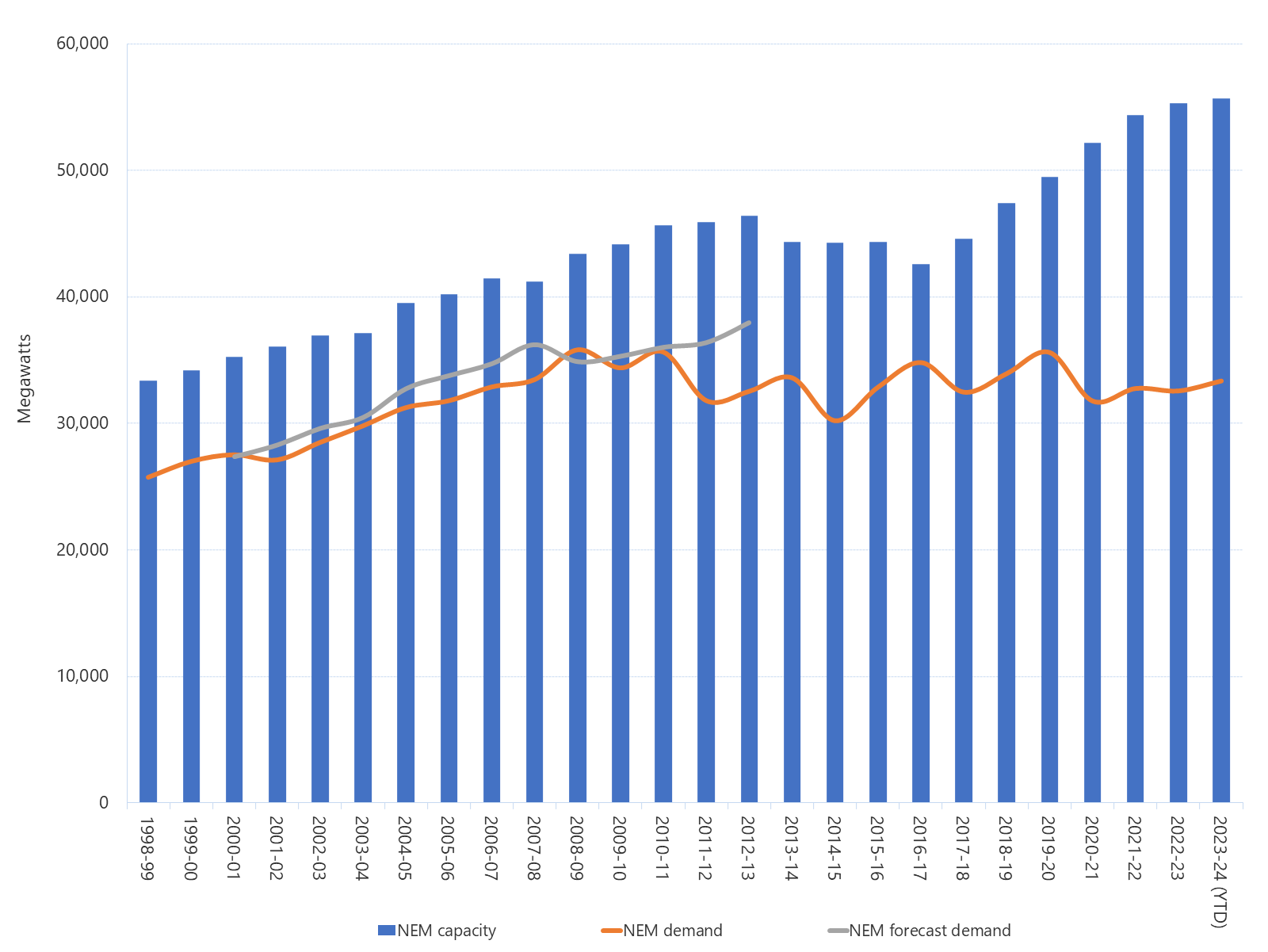
The nameplate capacity of just the NEM is 40,000MW - 55,000MW, with large scale solar already at 11,000MW, adding 6,000MW of Nuclear does what exactly?

[ 6 x 1GW AP1000 plants on East Coast: approx 12.5% current capacity ]

If we’re to get to Carbon Neutral by 2050, we’ve got to double total electric power generation, just to cover demands of transport. Which again makes the contribution of Nuclear much less significant.

Dutton's Big Plan is to add 5%-6% of total future capacity with Nuclear, while over 50% will have to be entirely new.
This is a marginal change to future supply, with half the output large scale solar PV [11GW] already installed, which itself is only 2/3 the size of the installed rooftop solar PV.

Growth in large & small scale solar PV continues to accelerate, already multiples of Dutton's proposed Nuclear capacity.

Rooftop Solar, especially with a in-home, EV or community battery, significantly eases Peak Demand and, being deep within the distribution network helps with stability, reliability and avoids blackouts.

Dutton can't seriously be proposing adding additional capacity that is a fraction of existing rooftop solar, but located a huge distance away, on an expensive, fragile distribution system, decreasing, not increasing Network resilience and limiting the impact of failures.

A more pressing issue than Nuclear Power is upgrading the East Coast NEM to high-voltage DC interconnects. Having one of the world's largest single AC electricity networks, 5,000km long, reduces the Network's stability, resilience and reliability.

The NEM operates on one of the world's longest interconnected power systems - from Port Douglas in Queensland to Port Lincoln in South Australia - a distance of around 5,000 kilometres. The NEM generates around 200 terawatt hours of electricity annually, supplying around 80% of Australia's electricity consumption.

The solution is to do what Europe and the USA are already doing: reducing the size of each AC network, which reduces the "Distribution Loss Factors", in particular the "Power Factor".

AC power, unlike DC, has three components: voltage, current and their alignment ("Power Factor"). Because AC voltage & current are constantly changing, they aren't necessarily aligned. Even if the generator is pushing out 1GW, the power-factor prevents 100% of it being available to customers. This is a major contributor to network losses and needs careful, constant management and adjustment.
GigaWatt AC-DC & DC-AC converters at each of transmission lines solves this problem and much more.

The economy grows roughly with population, so we might expert more energy will be needed in Australia in 2050 than now. Over time, technology & investment improves our "Energy Productivity", so total energy demand, outside residential where we know increasing rooftop solar & batteries will reduce demand significantly, will decrease per dollar of GDP.

In 1990, the most cost-effective, highest Return on Investment, form of Power Generation was developed: the Negawatt. It's many times cheaper to reduce wasted electricity, of 'negative watts', than to build a watt of new capacity, of any type. The notional 'generation' cost is zero, forever. There are local firms already specialising in this.

If Dutton's goal was to shore up the Grid, reduce (household) power prices and increase Grid reliability & stability, then he'd be investing in the simplest, most effective, highest return and lowest delay proven technologies and approaches - in which 'Negawatts' lead by very large margin, even over Solar & Wind.

In 2010 the Queensland Government under Anna Blight received a report on the states' Energy Future.
This plan for future needs was killed by the One Term Wonder, Campbell Newman.

Unsurprisingly, the same Qld Liberal National Party that Dutton hails from, showing the same disregard and disdain for the Future and Planning.

The QLD Smart Energy Future made the point there were a lot of very under-utilised assets, do nothing, waiting around for the 1% Peak Demand. 99% of time, those assets are idle, unable to earn income.

A pretty terrible return on investment, unless you’re making 80x-100x the average yearly revenue for that 1%, then merely ‘average’.

For Dutton's Power Co (DPC) to really provide "base load", it’s got to win supply contracts, stay near full capacity, 24hrs a day, always equalling the cheapest bidder, or undercutting.

Even if DPC sells power for 8,765 hrs / year, the revenue will be capped by the lowest bidder (Solar, Wind moslty) & negative during supply surpluses. They cannot come near a break-even averaged price.

So a “base load” DPC is designed to lose money, a lot of it.
Who pays? The taxpayer, by raising taxes or cutting services.
Which will the Liberal Party plump for? In the past, it's always been cuts to Services & Infrastructure.

So is Dutton’s plan to “Lower Power Prices, with Higher Taxes to cover huge losses”?
Not an election winner.

What will the DPC actually do in practice?

The same as the large, inflexible, expensive coal-fired power stations. running now at the margins:

sell nearly no base load, operate as “peakers”, cherry picking contracts during high demand, the $5,000 - $10,000 MW-hr range, hoping the Price x Utilisation total revenue will cover their high expenses.

Even a $500/MW-hr baseline needs 10% utilisation to break even, or ‘peak’ pricing for over 10% of the time, while the 2010 Smart Energy Future report suggests this is only 1%.

The economic test for viability of a Nuclear plant project is it versus storage, each providing the same PetaJoules per year to the grid, not acting as base load, but as intermittent "peakers".

I have not seen that calculation.
Burying storage deep in the grid, near consumers, increases Grid reliability & stability, lessens distribution network costs & losses and protects communities - taxpayer households - from blackouts, more so as more EV’s are charged at home and supplying power back to the grid. 

"Vehicle to the Grid" is likely to become a major 'generator' for Residential Peak Demand as adoption of EV's, and their massive batteries (50kW-hr - 100kW-hr), increases.

From the South Australian 100MW-hr Tesla battery, we know the “peaker” profile and performance needed for grid firming [ sub-millisecond response ]. Nuclear, as a steam driven generator, performs very badly as a “peaker” - they want a sports car but have bought a massive, slow, expensive Dump Truck, completely unsuited for our needs.

It’s possible that Nuclear Plants will be able, for a time, to break-even with 1%-2% utilisation - but only if there is perennial under-supply of power, routinely causing very high 30-min contract prices…

This is an unlikely scenario as Australian Super Funds have a mountain ($3.7 trillion currently) in savings looking for low-risk, high-return long-term investment opportunities, whilst right now and over the next 25 years, Australia has to double it's Electricity Generation capacity, to replace fossil fuel use.

For long-running Energy Market Stability & financial sustainability, Supply has to comfortably exceed Demand for >99%, probably 99.9% of the time.
The AEMO might have a model for long-term financial sustainability: it won’t be pretty for operators with a $500/MW-hr cost.

Which will increase the average price earned, borne by consumers: higher, not lower, costs.

For expensive Nuclear Plants to be profitable, consumers will have to pay higher electricity costs either directly or via higher taxes. The opposite of Dutton's claim of "lower prices".

The most likely scenario is for Dutton's Nuclear Power Co to be the most extraordinary White Elephant Australia has ever seen, while we can guarantee Dutton and the Liberal Party won't compensate taxpayers with the $100 Billion wasted.

Something that has to be included in large projects, especially for Nuclear Power, is the "Whole of Life" costs - not just building and operating, but shutting down, decommissioning, full remediation of the site and building 1,000 year safe 'repositories' for the high-level waste of spent fuel rods.
Presumably, this more than doubles the cost of already obscenely expensive power plants.

This is why Dutton can find no private investors willing to build his Nuclear Power Co, it's financially unsound and extremely high risk - all downside and no upside.
If his seven vanity reactors are built in 25 years, they'll end up as millstones around the taxpayers neck, and 'Stranded Assets' that multiple future generations of taxpayers will have to fund.

Compared to the alternative of large storage batteries deployed throughout the community, storing power when the Sun Shines and Wind blows for when it doesn't and times of Peak Demand, Nuclear isn't in the race... It's Storage and daylight.

Dutton cannot offer both “Lower Power Prices” and “No tax increase” without seriously cutting government services & tax transfers and knows it. This could be the most mendacious part of his plan... 


An EnergySmart Plan. Positioning Queensland for a Diversified Energy Future 2010 - 2050 

Nov 2010, Queensland Government report  

Ergon and ENERGEX will each spend $6 billion (that is $12B combined) in capital expenditure over the next five years to cope with extraordinary consumption during a fraction of the year, rather than the average consumption over the course of the year.

To put this into perspective, ENERGEX has over $900M in assets that are only used for approximately 3.5 days per year. (Mark Paterson, ENERGEX, The SPRA Standard).


Seismic Probabilistic Risk Assessment Possibly the SPRA acronym above.


AER: Review of Energex's maximum demand forecasts for the 2010 to 2015 price review

Modelling of Queenslands' power demand, including Spatial Reconciliation.


Energy data 

Australian Energy Statistics 

Australian energy intensity and energy productivity:  generating more $ of GDP per PJ


Australian Energy Update 2023 

Australian Energy Flows & Interactive HTML 

Energy Flows: where’s nuclear going to sit when heavy haulage goes Electric and network demand doubles?

Australian energy consumption, by sector 2021-22 [ PDF, Pg 11]

Table 14 National Electricity Market metered electricity generation, by fuel type [ PDF pg 34]

AEMO / NEM Market statistics: All charts
https://www.aer.gov.au/industry/registers/charts

Annual generation capacity and peak demand - NEM

This figure compares total generation capacity with peak demand (as at 1 April 2024) in the NEM since its commencement. It shows actual NEM peak demand and AEMO’s NEM peak demand forecasts.  


Australian Energy Update 2023 September 2023

 Figure 19 Cumulative capacity of accredited large-scale solar power stations [PDF, pg 32]


Wednesday, July 6, 2022

Long Response to Climate Change Denier, Letter to Editor, 2009

Cardwell_Renate-Metzger_Response

There are three broad responses to the Letter:

    1. Assumptions & Omissions
    2. Incorrect or should've known
    3. Examining Claims. [ Summary Response ]


Letter to the Editor to a regional newspaper, published in 2009.
Included as a submission to 2012 Senate Inquiry "The Social and Economic Impact of Rural Wind Farms".
Text at:
        https://stevej-on-misc.blogspot.com/2022/06/climate-change-denier-letter-to-editor.html

Sunday, July 3, 2022

Summary Response to Climate Change Denier, Letter to Editor, 2009

Original Document

Letter to the Editor to a regional newspaper, published in 2009.

Included as a submission to 2012 Senate Inquiry "The Social and Economic Impact of Rural Wind Farms".

Text:
https://stevej-on-misc.blogspot.com/2022/06/climate-change-denier-letter-to-editor.html

Long Response: Long Response


Summary response

What a hoot this letter is. Reminiscent of "Grampa" on the Simpsons, an angry old man shouting incoherently at the sky.

The author confuses 'area' and 'volume', more than once,

Monday, June 20, 2022

Climate Change Denier, Letter to the Editor in 2009. "Coal fired power stations are 96% efficient"

Below is the text of a Letter to the Editor to a small regional newspaper, published in 2009.

It was attachment 9 of a submission to 2012 Senate Inquiry "The Social and Economic Impact of Rural Wind Farms”. 

Part 2: Summary Response 

Part 3: Long Response


The context is during the "Kevin '07" Labor Government.

Monday, January 2, 2017

Creating effective Multi-Person Volunteer Groups

Creating effective Multi-Person Volunteer Groups as Unincorporated groups, Incorporated Associations or "Not For Profit" entities (Trust, Company, ...)

Comments derived from my experiences of NonProfits & Volunteer groups, using my research on Australian Skeptics Inc as a small case study.

Another puzzle piece: Richard Lead 'international tax expert' as Footnote in High Court case

Seems Richard was a phantom director for one of Vanda Gould's fraudulent off-shore Tax shelters.

Lead stuffed up in 2001, with unsigned Tax Returns naming Gould as the beneficial owner of the company (HWBB). Gould is claimed in newspaper pieces to be rather unforgiving of perceived slights - making sense of Lead's sudden disappearance from Aust. Skeptic magazine, but not the ASIC registered Foundation. [High Court Document, 2016, Lead's affidavit, 2012, and Hua Wang Bank Berhad v Commissioner of Taxation  [2014] FCA 1392]

There was also a 2004 tax case in the Admin Appeals Tribunal Australia (AATA) where Lead had to give testimony. The Judge deliberately mentioned his reluctance in giving evidence. Most names were disguised, including the beneficial owner, Gould. Which newspaper reports later unpicked.

This was the year Lead dropped from view. The judgement refers to him as 'independent accountant and tax consultant'. We might infer from that, that Lead was no longer in Gould's employ.

I once contacted the firm, CCS Partners, 154 Elizabeth Street, Sydney, Lead had used to audit the ASIC Foundation returns until 2004/5. They knew of Lead, years later, but referred me to him if I wanted a comment on his employment there.

In a webpage on Bougainville Copper Project, Lead's wife is noted as returning to her maiden name.
His address on formal documents changed as well.

Riverbend
http://www.riverbendnelligen.com/bougainvillelocation.html

Lead and others, ASIC Company Director Info for ACN-088-875-772.
ASIC search purchased for ACN-088-875-772.

Wednesday, July 9, 2014

Another part of the puzzle: Why the 'new editor' left in 2009.

I'd previously not found this on the web. It provides a good reason for why the new editor who replaced Barry Williams left. That the subsequent and current editor, Tim Mendham had been a long-term member of the inner-circle, including being the Editor before handing over to Barry W. It was noted in the Magazine that Tim M "was wearing 5 hats": Editor, Public Officer, Archivist, Treasurer and ???.

The timing, especially in relation to being Deregistered, would be interesting to know. Stollznow seems to have a history of questionable behaviour.

Monday, May 21, 2012

In Their Own Words: What the magazine says.

There are 81 full issues of the Skeptic on-line, from 1990 #1 until 2011 #1.
The remaining 2011/2012 issues are only published in-part on-line following a website policy of only publishing in-full after 12 months.

These 81 issues comprise 5294 pages total [~65pp/issue average] with 5230 text pages in total and around 3.5M words of text.

I've carefully searched this public record for answers to the questions underpinning "Who are the Australian Skeptics? On the Public Record, what is the phrase "Australian Skeptics" intended to mean?":

In Their Own Words: What the website says.

Subscribers are still not Members after 15 years.

Short form:
  • The "Who we are" page is internally inconsistent:
    • the term "Australian Skeptics" is used in contradictory and exclusionary ways, without being clarified, to mean both "the collective of Sceptics in Australia" and only the members of Y0133609.
  • There are 1000-1500 potential members in NSW who have been denied membership, which prime face suggests an investigation is warranted, or must be treated as the General Public purchasing the magazine, which might constitute carrying on a Commercial Activity, contrary to the Objects of the Act.
  • The confusion can be quickly and trivially fixed in multiple ways, but after ~15 years the confusion remains.
  • The Office Bearers, Committee and Editors/Executive Officers of Y0133609 have collectively and knowingly allowed this confusion to remain for ~15 years. I can't see any any legitimate purpose this might serve. Claiming they were ignorant of the confusion or they've been indolent, negligent, careless or worse is to claim they were derelict in their duties.

Saturday, May 19, 2012

By Sate percentages subscribers to The Skeptic, 1996.

This 1996 article appears to indicate the then relative number of subscribers per State to the Skeptic.

Vol 16, No 4 the skeptic p 63 [1996]

Saturday, May 12, 2012

Questions for Y0133609, Australian Skeptics Inc.

Arising from their Financial Reports, there are a number of serious questions the Office Bearers and 16 members of NSW Association Y0133609,  "Australian Skeptics Inc" need to answer:
  • The Primary Activity of Y0133609 has been to publish the magazine, The Skeptic.
  • The Primary Purpose of Y0133609 has been the activities and finances related to the magazine.
  • Y0133609 has been carrying on a significant Commercial activity in selling the magazine to the Public.
  • The Office Bearers of Y0133609 have been seriously remiss and derelict in their duties:
    • The failure to lodge returns from 1996-1999. Once is an accident, more is not.
    • The minimalist account data provided in the 1996-1999 returns, if presented to members, would not allow them to create a full and informed view of the Association activities or operations as can be shown by earlier and later accounts. If fuller accounts were presented to members, why would they not be filed?
    • The failure to lodge returns for the following 10 years. This is negligence, incompetence or deliberate - any and all of which should be enough to dismiss the Committee and appoint an Administrator.
    • The failure to lodge returns for the years GST was paid, 2001, 2002 and accounts must have been prepared for ATO filings.
    • Failure to notify a change of Public Officer for 5 years.
    • Trading using the Association name, bank accounts and credit card for the ~10mths De-Registered period, 25-May-2009 to 06-Apr-2010.
  • The structure and name do not reflect the Association Activities.

Friday, May 11, 2012

Financial Reports as filed for NSW Assoc Y0133609: Australian Skeptics Inc, aka NSW Skeptics

These are data extract from the Financial Reports as formally filed by the Association, with subscriber numbers as reported in the magazine, The Skeptic.

Thursday, May 10, 2012

Editor of "The Skeptic": summary response to AR Editor questions.

This email conversation was supplied on condition it be published with this preamble:
At the end of 1999, the Australian Rationalist received a draft of an article by Victorian Skeptic Adam Joseph, raising some issues regarding the operations of the national body, the Australian Skeptics. Around about the same time former AS committee member Steve Roberts posted a set of criticisms of the Skeptics on the internet. The AR Editor, Ian Robinson, worked with Joseph to produce a final version of the article in April, 2000. Before publishing the article, Robinson emailed Skeptics CEO Barry Williams itemizing the criticisms and invited his response. Williams provided a detailed response to the criticisms. Subsequently, the Australian Rationalist Editorial Board decided not to publish the Adam Joseph article in the journal.  Williams’ reply to Robinson’s email is reproduced below, together with the points in Robinson's email that he was replying to, without which his comments are meaningless .  The green-coloured text is Robinson’s email, quoted in full and the blue text is Williams reply or a synopsis of it, interspersed at the appropriate points.

Wednesday, May 9, 2012

Editor of "The Skeptic": Didn't take the piece well... Full-text

This email conversation was supplied on condition it be published with this preamble:
At the end of 1999, the Australian Rationalist received a draft of an article by Victorian Skeptic Adam Joseph, raising some issues regarding the operations of the national body, the Australian Skeptics. Around about the same time former AS committee member Steve Roberts posted a set of criticisms of the Skeptics on the internet. The AR Editor, Ian Robinson, worked with Joseph to produce a final version of the article in April, 2000. Before publishing the article, Robinson emailed Skeptics CEO Barry Williams itemizing the criticisms and invited his response. Williams provided a detailed response to the criticisms. Subsequently, the Australian Rationalist Editorial Board decided not to publish the Adam Joseph article in the journal.  Williams’ reply to Robinson’s email is reproduced below, together with the points in Robinson's email that he was replying to, without which his comments are meaningless .  The green-coloured text is Robinson’s email, quoted in full and the blue text is Williams reply or a synopsis of it, interspersed at the appropriate points.

Monday, May 7, 2012

Pitch to ABC's Background Briefing: There's Trouble at Mill.

Sent to ABC Radio National's Background Briefing, Mon 07-may-2012 via their contact page.
Some editing [and comments].


It isn't on the breath taking scale of the HSU drama, but here's a documented tale of 20 years of rorting the system.
You absolutely know that if there's one, then there's more... [But how can we find those?]

You'd think a largish organisation who's Patrons were Dick Smith and Phillip Adams would have a high degree of integrity, but the opposite is the case...

Sunday, May 6, 2012

Australian Skeptics Inc: 2012 Update

This is an update on the Association and players. [I expect feedback to correct and expand this.]

Reasons to be Skeptical: Joe Needham response to Adam Joseph in Forum comments

[Prev]Table of Contents


Re: [Skeptics Forum] A Liar or a fool? Maybe both.

At 02:29 AM 04/05/2002, Adam Joseph wrote:
Barry Williams now belongs to this group and responds to mail. What a turnaround!! That means Needham doesn't have to be the go-between any longer. Sorry about that Joe. And may I commend you on your language this time round. You do recall the filth that streamed out of your keyboard before don't you? Had some therapy recommended by Carlson or the others? Good boy.
Sorry to disappoint you but the Cox News Service has been cross posting and that is how Barry Williams message ended up here. Barry Williams is not a member of the Skeptics-Forum.
In Barry Williams post, (at the end of this) he mentioned I walked out of the Australian Skeptics because I wanted his job. Most people around that time were very aware that I believed in a good rotation of committee people and so on. So that's lie number one.
Doesn't Barry Williams hold a paid position with the Australian Skeptics? His job is not one that normally rotates but he serves at the pleasure of those who rotate on and off of administrative posts.
He also said I put out a multi-page screed to the media and others. True.
AH-HA Guilty as charged!
And this had no effect, eliciting only "Who is this idiot?" Given that what I released to the media was a background briefing on the Australian Skeptics and most things people should know, it most certainly did the trick. The media rarely goes near the Skeptics these days. And that was the purpose of the exercise. Simply, they are seen as having little credibility left. Years back, a fortnight would not go by when some publicity involving skeptics would surface. On the rare occasion close to Christmas they would put Santa look-alike Barry Williams on for a minute to say one shouldn't believe in psychics. Wow! I somehow think people got that message years back.
You must be a sorry piece of crap to try to discredit a whole organization because you don't like one person.
I see he is now denying he related information in his biography to the Rationalists International claiming 'an engineering background', which to my mind suggests he could be an engineer. I believe that to be another untruth.
Do you know what Barry Williams background has been?
So why should I even bother mentioning any of this on this particular forum?  Because it promotes itself as a sceptical forum that's why. And if people like Williams turn up,or are mentioned, then you have a right to know that even some Skeptics groups around the world have very odd and somewhat dishonest people involved. I have merely exposed people within the Australian Skeptics who have lost the whole group credibility galore.
You are the only one who has mentioned Barry Williams. It's not like his name just keeps turning up. You were surprised to learn that some of us Yanks actually know Barry. Our knowledge of Barry Williams rained on your little parade.
There was the case of Harry Edwards a couple of years back. Stalwart and secretary with the Australian Skeptics for 17 years. He had a falling out with Barry Williams and suddenly found himself thrown out on allegations of so-called corruption. When the trumped-up matter came to court, it was thrown out. Williams and a couple of his cronies then threatened to go to the supreme court. People within the freethought movement in Australia are still waiting.
Totally unfamiliar with the case. Got any on-line news stories about it?
Anyone who dared ask for evidence of Harry Edwards guilt,including state committees, were told and shown nothing. May be Williams would like to post the 'evidence' on this forum. 'Evidence' that is supportable of course, not Williams renowned bullshit.
Australia must be a strange place. In the US an individual cannot refuse to turn over evidence in a crime or,if they do, they have time to think about that decision in jail.
So for those who need more on the trials and tribs of the somewhat discredited Australian Skeptics, what Australian skeptics regard as a small but definitive history really, 'cept Williams of course, the continue reading below.
I'm surprised the entire continent hasn't sunk into the ocean in disgrace.

{Short attention span caused me to delete the rest of your message in my reply.}

Regards,

Joe Needham AIM: JoeNeedham | YM: jneedham | ICQ: 1674329
http://forums.delphiforums.com/skepticsclub/ | www.internet-skeptics.org
http://groups.yahoo.com/group/skeptics-forum/
Do NOT let them deceive you with the legitimization of their myth!™


[Prev]Table of Contents

Reasons to be Skeptical: Barry Williams response e-mail

[Prev]Table of Contents[Next]


From: "Barry Williams" <skeptics@...>

Reluctant as I am to give any credence to astrologers and other necromancers, can it be simply a coincidence that in the very month that five planets will line up in the sky, Adam Joseph should once again emerge from his self-pitying swamp to tell the world just how much he dislikes me?

For those readers lucky enough not hitherto to have been the recipient of one of Joseph's turgid diatribes, here is an encapsulated history. In the early 1990s, Mr Joseph was president of one of the
state bodies that makes up Australian Skeptics. In about 1995, he decided that I had too much power, and further decided that he should have that power. In the event, no one else agreed with him, so he
departed in a huff (he might have departed in a Toyota, but I believe it was a Huff). In Oz parlance, this is known as "spitting the dummy".

Ever since then, every couple of years or so, he has assaulted everyone he can think of with barely coherent rants, in which he enumerates all my faults -- most of which are simply figments of his
febrile imagination (he has also misssed out on quite a few -- so much for his research). Just before the 2000 World Skeptics Convention in Sydney, he targetted all manner of prominent Skeptics and the media with a multi-page screed (17 or 18 pages from memory), which had precisely no effect on the success of the Convention, eliciting from the recipients only the question "Who is this idiot?"

As for his specific (insofar as anything he says is specific) rant this time, I cannot imagine just how I would "[go] around inferring in many quarters" that I am an engineer. I suppose that, had I suffered from a serious bout of amnesia, and then discovered that my house was full of engineering texts, I might possibly "infer" that I was an engineer, but that hasn't happened, so I don't know what he is drivelling about this time. Furthermore, I haven't even "implied" that I am an engineer in any quarters, far less claimed it.

His bile directed against Joe Needham is even less rational, as he has never met Joe, and clearly knows nothing about him. It seems to stem from the fact that Joe once read one of his peurile raves, and pointed out to him that he was talking through his fundament. Still, Joe can now be satisfied that he belongs to a longish list of distinguished Skeptics against whom Adam Joseph has vented his spleen. It's doesn't quite have the cachet of being described as a "tool of Satan" by a creationist, but it has never done anyone's reputation any harm.

For the past year or so, Joseph has been quiescent, which is what causes me to wonder about manifestations of his outbreaks of bile and planetary alignments. There's definitely a research project in there for someone who is looking for a topic.

Barry Williams -- Editor -- the Skeptic


[Prev]Table of Contents[Next]

Reasons to be Skeptical: Appendix: Dr Steve Roberts list of questions.

[Prev]Table of Contents[Next]


'He's a man you must believe ‘ Dr Robert[s]'
John Lennon & Paul McCartney

In 1995 Victorian committee member Dr Steve Roberts communicated the following (edited) criticisms of the 'national' committee to Adam Joseph.
He subsequently withdrew them and was later appointed as the only interstate member of the 'national' committee in Sydney. He has since been dumped but remains active within the Victorian Skeptics branch.

1. Competence of the National Treasurer

Anyone can see that the national committee's accounts are a farce - as bad as its minutes - and it is obvious that the treasurer is not able to make the simplest statements about how much money we have, or the simplest forecasts of future obligations such as magazine printing. [S]omeone else should take over the Treasurer's job ASAP. If Sydney start to bleat that nobody else wants the job, Victoria can offer one of the several people here that could do it, and do it better. It is supposed to be a national committee, after all.

2a. National committee has lost its sense of identity and direction

Effectively the national committee is two people, who sometimes can't even talk to one another on important topics such as where conventions ought to be held. There is no guidance or leadership as to where the Skeptics are supposed to be heading. Tasks often get put off for long periods, resulting in increased costs. When I volunteered to be a member of the national committee last year this was accepted, but I have heard nothing since. It is quite possible to run a committee across several cities, using only the postal system with perhaps the occasional fax.

2b. National committee is confused with NSW committee

These are one and the same body, which has led to national funds being squandered on local NSW projects. In the past this has not mattered much, but these days more is happening in Melbourne than anywhere else and I believe that we should have the use of some of the lavish Skeptics equipment that is lying relatively idle in Sydney.

3. Use for funds, including the inheritance

We (Australian Skeptics) have no idea what to do with sums of money that come our way. It does not matter if a gift is $500 or $500,000 - we ought to have ambitions and draw up plans which could be executed if money came in. The CSF, for example, do exactly this. When I put this to Barry [Williams], he seemed to refuse to think about it. Projects attract funding - look at the US$2M centre that CSICOP/CODESH put up in 1993 (already being extended, with further appeals for money being sent out). The point is that there is money out there just waiting for a use to be offered for it.

4. Work load falling on too few individuals

A common gripe in all amateur societies. Blame me too - with increasing family and work commitments I keep finding I have to back away from doing things. The situation seems to be much worse in Sydney where I would estimate 80% of the load falls on Barry, 19% on Harry [Edwards] and 1% on anyone else. A body like the Skeptics needs a diverse set of enthusiastic people as well as being to get a crowd together.

5. Skeptics have drifted away from "investigation" towards "critical thinking"

However the general public knows what we are all about. I am not sure if we should change our charter, since to do so would be interpreted by our enemies as "Ha! They don't dare investigate because they know they will come across the REAL TRUTH about (ufo's, creation, crystals, etc.)". Also the common meaning of the word "critical" is now something like "abusive". Strictly "to criticise" means more like "to discuss the good and bad aspects of", but only pedants like myself care about that. Maybe the Skeptics should "encourage a questioning attitude" ??

6. Two big jobs (National President and Editor) held by same person

Maybe because of a lack of volunteers. I doubt if many people can afford he time that either of these posts must require. I don't think that we need a National President at all, Barry can be NSW President with equal effect in NSW, thus freeing you and others to hold more independent-sounding posts in Victoria. The Press in Melbourne doesn't like to quote Sydney people, and I'm sure vice versa.

7. Barry is acting autocratically

Stories of what Barry [Williams] has said continue to shock me, especially as he holds two powerful posts. Barry can be identified with Australian Skeptics, but not to the extent that Mark Plummer (and Paul Kurtz in CSICOP) wanted to be. We should NOT have a personality cult around the President, cuddly though he may be. The sort of arrogance I object to includes:
  • insisting on a disastrous venue for the 1994 convention;
  • mismanaging the assignment of the 1995 convention;
  • refusing to debate Harry [Edwards]' motion about magazine size;
  • refusing control over editorial content of the magazine, and my favourite perennial one
  • declining to send me the full membership list (which had at least two Victorian members with wrong postcodes) on the grounds that I hold another post in another Society.
Well, so does Harry Edwards.

8. Presentation of the magazine

This is low on my list of concerns because I am aware that the presentation has improved since Barry took it over. Also, the magazine is (or should be) renowned for its content, not its cover. I can easily believe that hard-paper, coloured covers are within reach, as are alternative ways of wrapping it for mailing. But overall I like the format and layout generally. It is unrealistic to try to sell it through newsagents (we would need to print many more copies for that to be worthwhile; Dick Smith would advise, or better still, I can ask my mate Lyle Rumble of Southern Sky astronomy magazine, who has recently done this).

9. Content of the magazine

Again low on my list because I think its not too bad. There are a lot of good articles but there have been some shonky ones, which ought to have been weeded out by an editorial committee, had one existed.

There are still too many typos and misprints (although nowhere near as bad as when Tim Mendham was editor) to allow me to show off articles with pride as something the Skeptics are doing.

ENDs


[Prev]Table of Contents[Next]